Bamboo Blade Manga Volumes: All 14 Books Explained
All 14 Bamboo Blade Manga Volumes: High School Kendo Action from Start to Finish
Bamboo Blade is a completed series spanning 14 manga volumes and 102 chapters, all of which have been published in English by Yen Press (a publisher specializing in translated Japanese comics). If you’ve been curious about this series and wondering how many Bamboo Blade manga volumes you need to track down, here’s the good news: it’s a fully finished, fully translated collection with a clear beginning and end.
For anyone new to the format, manga are Japanese comic books that are typically read right-to-left. Stories are first published chapter-by-chapter in magazines, then collected into bound books called volumes — so those 102 chapters are packaged across the 14 volumes you’d buy and read.
The series was written by Masahiro Totsuka (土塚理弘) with art by Aguri Igarashi (五十嵐あぐり), and it was serialized in Young Gangan, a manga magazine published by Square Enix (a major Japanese media company) from December 2004 to September 2010 (with the final collected volume, Vol 14, released in November 2010). That’s a solid five-year run that tells a complete story without dragging things out.
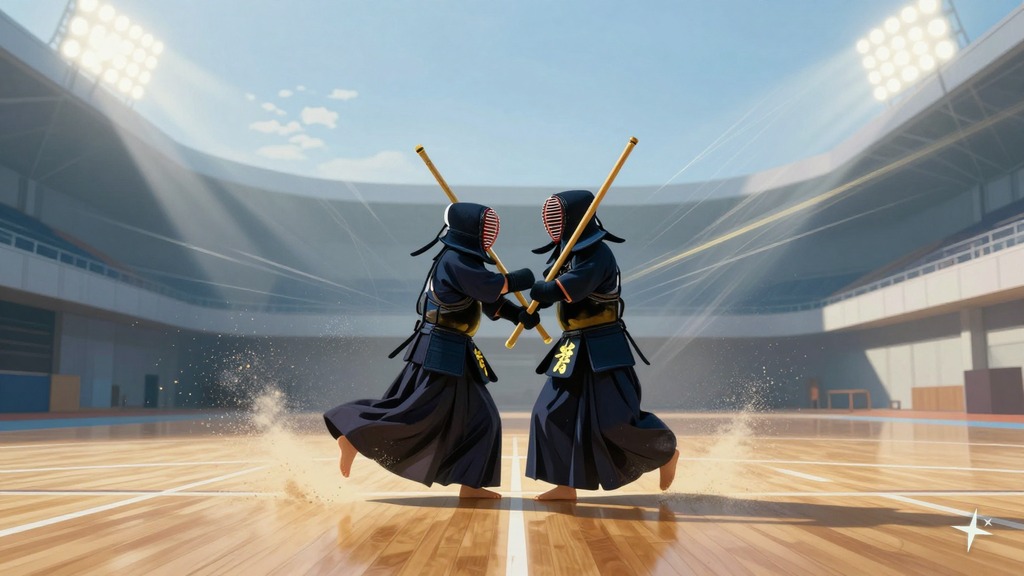
So what’s it about? Bamboo Blade follows a high school kendo club. Kendo is a Japanese martial art based on swordsmanship — practitioners wear protective armor and spar with bamboo swords called shinai. The series centers on a struggling team with a coach who makes a bet that his female kendo squad can beat a rival school’s team. What starts as a somewhat comedic setup evolves into a genuinely compelling sports story about competition, teamwork, and personal growth. The kendo matches are detailed and exciting, and the character dynamics keep things lively throughout.
At 14 volumes, this is a very manageable collection. You’re not signing up for a 40+ volume commitment like some longer-running series demand. You can read the whole thing, start to finish, and own a complete set on your shelf without worrying about new volumes dropping later.
How to Collect All 14 Bamboo Blade Manga Volumes
Here’s the practical side: how do you actually get your hands on all 14 books?
Yen Press published the entire English run, meaning no volumes were skipped or left untranslated. Every chapter from the Japanese edition made it into English. That’s worth noting because some older series had their English translations discontinued before they were finished — Bamboo Blade doesn’t have that problem.
Physical volumes are the primary format for Bamboo Blade. The series was released during a period when digital distribution for manga wasn’t as widespread as it is now, so physical copies were the standard. Digital editions may be available depending on the platform, but if you’re specifically looking for digital, check current storefronts to confirm availability — it can vary for older Yen Press titles.
For budget-conscious collectors, individual volumes from Yen Press typically carry a cover price in the range common for standard manga paperbacks. However, since the series ended well over a decade ago, the secondhand market — sites and stores that sell used books — is often your best friend here. Look for bundle or lot listings where sellers clearing out their collections will sometimes list multiple volumes (or even full sets) together, which brings the per-volume cost down significantly compared to buying each book individually.
One thing to keep in mind: as an older Yen Press title, individual volumes may vary widely in availability. Some might be easy to find at typical retail price, while others could be scarcer. If you spot a volume at a reasonable price, it’s generally worth grabbing it rather than waiting — older manga stock doesn’t tend to get more available over time.
The final volume, Vol 14, carries ASIN 0316189588 if you’re searching for it specifically online.
Bamboo Blade
Complete Volume List with Key Picks
All 14 volumes are worth reading in order — this is a story that builds on itself, and skipping around means missing character development that pays off later. That said, here are some milestone volumes that represent major turning points in the series:
Vol 1 — Where It All Starts
This is your entry point. You’ll meet the kendo club, get introduced to the main cast, and learn about the bet that kicks the whole story into gear. The tone here is lighter and more comedic, establishing the underdog team — a group of mismatched students nobody expects to win — whose journey carries through the series. If you enjoy Vol 1, you’ll enjoy the rest.
Vol 3 — The Team Comes Together
By Vol 3, the roster is solidifying. Early tournament action begins, and you start to see the individual fighting styles and personalities of each team member. This is where the series shifts from “fun setup” to “okay, I’m invested.”
Vol 7 — Midpoint Escalation
The halfway mark raises the stakes. Competition gets more serious, opponents get tougher, and the characters are pushed beyond their comfort zones. Vol 7 is where Bamboo Blade really demonstrates that it’s more than just a comedy with kendo — the sport itself starts to matter deeply to the characters, and you feel it.
Vol 10 — Peak Tournament Intensity
Late-series tournament action hits its stride here. Character development reaches some of its highest points, and the matches carry real emotional weight. If you’ve been reading along, Vol 10 is where a lot of story threads start converging in satisfying ways.
Vol 14 — The Finale
The final volume wraps up the competitive storyline and the character journeys that have been building across all 102 chapters. Without spoiling anything, the ending gives the story proper closure — something not every manga manages, especially sports titles that sometimes end abruptly.
Here’s a quick overview of all 14 volumes:
| Volume | Story Phase |
|---|---|
| Vol 1 | Introduction — the bet, the club, the cast |
| Vol 2 | Early recruitment and club building |
| Vol 3 | Team roster solidifies, first tournaments |
| Vol 4 | Expanding rivalries and training |
| Vol 5 | Deepening character backstories |
| Vol 6 | Pre-tournament preparation and tension |
| Vol 7 | Midpoint escalation — serious competition begins |
| Vol 8 | Continued tournament battles |
| Vol 9 | High-stakes matches and setbacks |
| Vol 10 | Peak intensity — character and competition peaks |
| Vol 11 | Building toward the climax |
| Vol 12 | Late-game rivalries and emotional moments |
| Vol 13 | Next-to-last storyline — everything on the line |
| Vol 14 | Finale — resolution and closure |
Volumes That May Be Hard to Find
This is the reality of collecting a completed manga from the late 2000s: some volumes may be out of print — meaning the publisher is no longer manufacturing new copies, so only existing stock remains. Here’s what to expect.
Mid-run volumes tend to be the scarcest. This is a pattern across older Yen Press titles (and older manga in general). Vols 1 and 14 tend to have better availability because first and last volumes see the most demand and often get the largest initial manufacturing runs from the publisher. It’s the volumes in the middle — think Vols 5 through 10 — that can be trickier to track down at reasonable prices.
There are no confirmed reprint waves for Bamboo Blade. Availability depends on remaining retail stock and whatever shows up on the secondhand market. This isn’t a series with the mainstream name recognition that drives reprints, so what’s out there is largely what’s out there.
Tips for hunting down scarce volumes:
- Check multiple used-book platforms regularly — stock rotates as collectors sell off their shelves
- Set up alerts or saved searches for specific volume numbers so you get notified when they appear
- Consider “acceptable” or “good” condition copies rather than holding out for “like new” — for reading purposes, a slightly worn spine doesn’t diminish the story
- Digital editions may help fill gaps if physical copies prove too scarce or expensive for certain volumes
If you’re building the set over time rather than buying all at once, patience is your biggest asset. Volumes that seem impossible to find one month can show up the next.
A Finished Series — Your Collection Stays Complete
One of the best things about collecting Bamboo Blade in 2026 is that the story is completely finished. The manga ended in November 2010 with Vol 14. There are 102 chapters across those 14 books, no ongoing serialization, and absolutely no risk of needing to buy additional volumes later.
When you own all 14, you own the whole story. That’s it. Your shelf is complete.
About the spinoffs: Several spinoff series exist, the most prominent being Bamboo Blade B, followed later by Bamboo Blade C and BB Deformer. Collecting the original Bamboo Blade does not require picking up any of them — the original 14 volumes tell a self-contained story with its own beginning, middle, and end. None of the spinoffs have been licensed in English — they are only available in Japanese, so English readers cannot purchase them through standard storefronts. They are entirely optional to the original story regardless.
About the anime: A TV anime adaptation (an animated television series based on the manga) covers a portion of the manga’s story — generally said to span roughly the first half. It’s a nice companion piece, but the manga is the complete version of the story. The anime can serve as a great entry point — if you watch it and want more, the manga continues well beyond where the adaptation leaves off and goes further.
This “finished and complete” status is genuinely valuable for collectors. There’s no waiting for the next volume, no worrying about whether the series will get cancelled before it concludes, and no anxiety about a publisher discontinuing the English release mid-run. Everything that was written has been translated and published. Done.
Who Should Collect Bamboo Blade
Fans of sports manga who want a complete, finite set. Sports manga is a genre of Japanese comics focused on athletic competition — series like Haikyuu!! (volleyball) or Slam Dunk (basketball) are well-known examples. If you enjoy those kinds of stories but want something you can finish without committing to dozens upon dozens of volumes, Bamboo Blade fits that niche perfectly. A quick note on tone: Bamboo Blade leans lighter and more comedic than a series like Haikyuu!!, which tends toward intense emotional highs and lows. Think warm humor with heart rather than gut-punch drama. At 14 volumes, it’s substantial enough to tell a rich story but short enough to collect without a major time or money investment.
Kendo enthusiasts. This is one of the very few manga focused entirely on competitive kendo. The sport isn’t represented in manga nearly as often as baseball, basketball, soccer, or volleyball. If kendo is your thing — whether you practice it, watch it, or are simply curious about it — Bamboo Blade is one of the best ways to see the sport depicted in manga form.
Readers who enjoy character-driven stories with a comedic tone. Bamboo Blade isn’t a grim, intense sports drama. It has heart and humor alongside its competitive moments. The underdog team setup gives it warmth, and the cast is genuinely fun to spend time with. If you like stories where you care about the people as much as the competition, this delivers.
Collectors who appreciate a clean, complete set. Fourteen matching spines on a shelf, telling one complete story. There’s something satisfying about that, especially in a hobby where so many series are still ongoing or have complicated publication histories. Bamboo Blade is straightforward: 14 volumes, one publisher, one continuous story.
If any of that sounds appealing, grab Vol 1 and see how you feel after the first few chapters. The series hooks most readers early, and knowing that you’ve got a complete 14-volume journey ahead of you — with a real ending waiting at the finish line — makes it easy to commit.